
Twenty-eight years ago, I came to Japan with a scholarship and a laptop. I did not plan to build a software company. But Japan has a way of changing your plans. What I found here was a market that values reliability over novelty, relationships over transactions, and long-term commitment over short-term returns. Those values shaped how I work, and later, how we built The Plant.
They also helped me see a problem that kept appearing again and again.
For more than two decades, we worked inside Japanese enterprise environments across fashion, retail, food, media, and finance. The industries were different. The teams were different. But the underlying issue was often the same.
The gap we kept seeing
In Japan, enterprise commerce often sits between two imperfect options.
International platforms bring strong architecture, global standards, and the reassurance headquarters expects. But Japan is rarely where their roadmap starts. The local team may need LINE integration, specific payment flows, loyalty mechanics, delivery logic, or a seasonal retail rhythm that is obvious to anyone operating here. Yet those needs can sit in a global queue for months.
Local vendors often understand the market much better. They know how Japanese businesses buy, approve, operate, and support technology. But they may not always provide the flexibility, documentation, governance, or modern architecture global teams need when Japan is part of a larger international business.
The global solution is not local enough while the local solution is not global enough. And the people in the middle carry the cost.
Customer data in one place. Product information somewhere else. Orders, content, campaigns, loyalty, and reporting spread across different systems. People exporting files, reconciling numbers, waiting for approvals, checking with another vendor, or explaining the same local requirement repeatedly to teams far from the market.
None of this is dramatic on day one. But over time, the coordination effort becomes part of how the business operates.
Why this matters more now
For a long time, Japanese companies could absorb this kind of friction through effort, patience, and people. That is becoming harder as labor costs rise and demographic pressure shrinks the available workforce. Experienced operators are already stretched. At the same time, customer expectations are not slowing down. Customers expect faster service, more relevant communication, consistent experiences across channels, and fewer excuses when something does not work.
The old answer was to add people, meetings, spreadsheets, and patience. In Japan, that answer is becoming harder to sustain.
This is why fragmented systems are no longer just a technology problem. They are an operational problem. If teams spend too much of their time coordinating between tools, they have less time to improve the business, serve customers, launch ideas, and respond to what is happening in the market.
That is the context in which we built QORTEX.
What we built
QORTEX is the commerce suite we have built and refined through more than 20 years of enterprise work in Japan, now offered as a product in its own right.
It did not come from a whiteboard exercise or from chasing the latest industry hype. It came from client work, production systems, long relationships, difficult launches, operational constraints, and the repeated observation that ambitious companies in Japan were being underserved.
Most serious companies already have customers, stores, systems, approval flows, revenue targets, and teams doing their best to keep everything moving. They cannot stop the business in order to improve it. QORTEX was built with that reality in mind: it can replace existing systems where that makes sense, or connect with what is already there so teams can move step by step instead of changing everything at once.
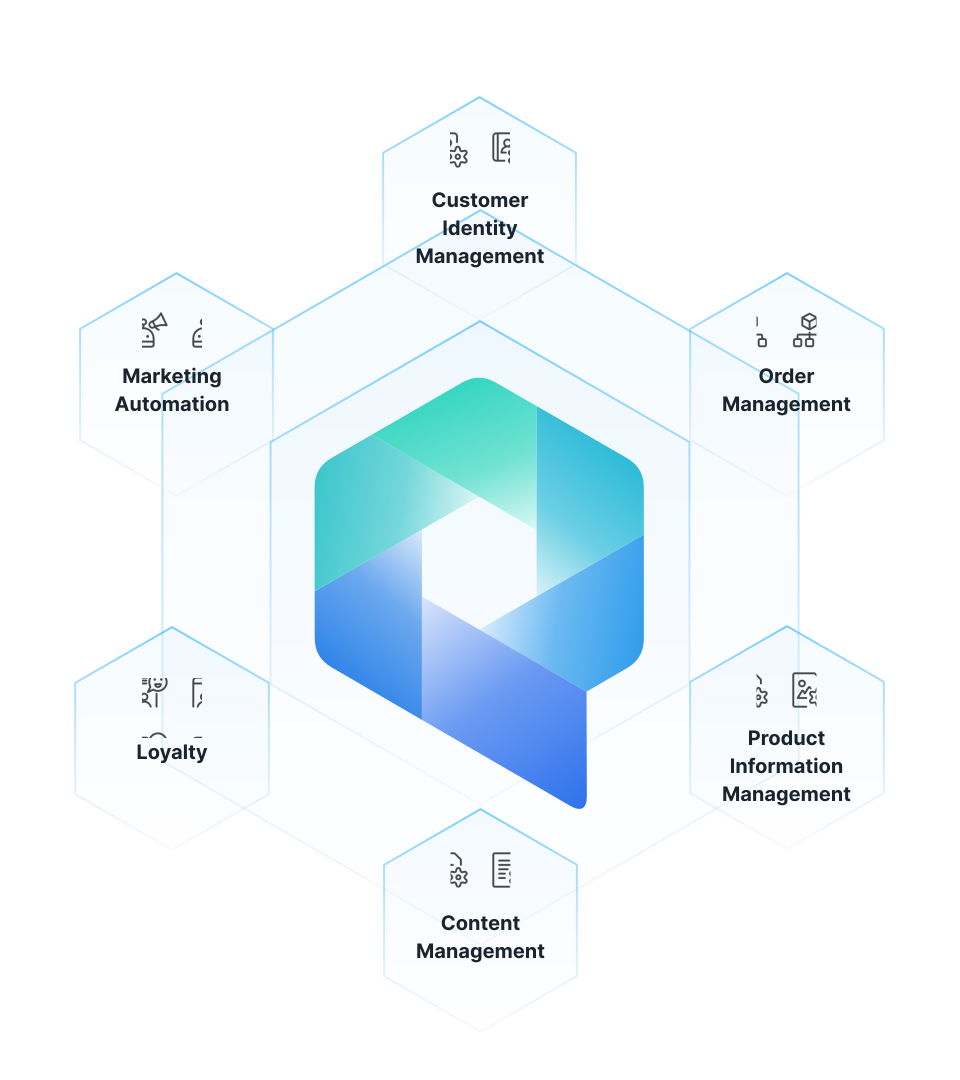
AI is built into how QORTEX works, not bolted on as a headline feature. It operates inside the suite day to day, surfacing signals, recommendations, and next steps. But we have never believed that enterprise systems should remove human judgment. The goal is to help teams see more clearly, move faster, and decide when and how to act.
That belief shaped not only the product, but also the way we deliver it.
One team, accountable from start to finish
One lesson I learned the hard way is that enterprise projects rarely slow down because the technology is impossible. They slow down because too many parties own only part of the problem.
The platform vendor owns the product. The implementation partner owns the setup. Another team owns daily operations. A separate agency may own content or campaigns. When something goes wrong, context has to travel through the chain before anyone can act. With QORTEX, we wanted to remove that ambiguity: the same team owns the technology, the implementation, and the ongoing operation.
That does not make every project simple. Enterprise work is never simple. But there is one accountable team with the context to understand both the system and the business reality around it. Our approach reflects that — we start by understanding how the business actually operates: workflows, constraints, existing systems, and the internal path to decision-making. Success is measured by what becomes easier, faster, or more reliable for the business.
International by nature, Japan by choice
The Plant was never a company that fit neatly into one box. From the beginning, we had people who came to Japan from different parts of the world and stayed, and Japanese team members who built their careers across languages, expectations, and business cultures. That became part of how we solve problems.
We are not a Japan subsidiary of a global technology company. We are also not a traditional Japanese vendor. We sit somewhere in between.
For clients, that matters because commerce decisions in Japan are rarely only local or only global. The local team needs systems that fit daily operations. Headquarters need confidence, documentation, governance, security, and standards. Both sides need to understand what is being decided and why. Bridging context, priorities, and decisions in both directions is harder to achieve than pure translation.
Built for what we kept seeing
QORTEX is the result of a pattern we kept seeing for long enough that building an answer became the only logical next step.
Japan has many ambitious enterprises with strong brands, deep customer relationships, and serious operational capability. But too often, their commerce teams are forced to work around systems that were not built for the realities they face.
We built QORTEX because we believe those companies deserve better: technology with global standards, Japan depth, and one accountable team behind it.